Gridshells
The Premise
The construction industry is structurally committed to permanence, yet most of what it builds will eventually be destroyed. Inspired by ephemeral structures like Burning Man's Galaxia, this project asks a different question: what if disassembly were a first-class design constraint? Not an afterthought, but the primary driver of form.
A continuous gridshell is mechanically ideal. It is also logistically impossible to ship. A 30-meter dome cannot travel in a standard container, so the structure must be cut into prefabricated panels. But every cut is a joint, and every joint degrades global stiffness. The design problem is therefore this: how do you discretize a free-form surface into shippable pieces while preserving as much structural integrity as possible?
The Formulation
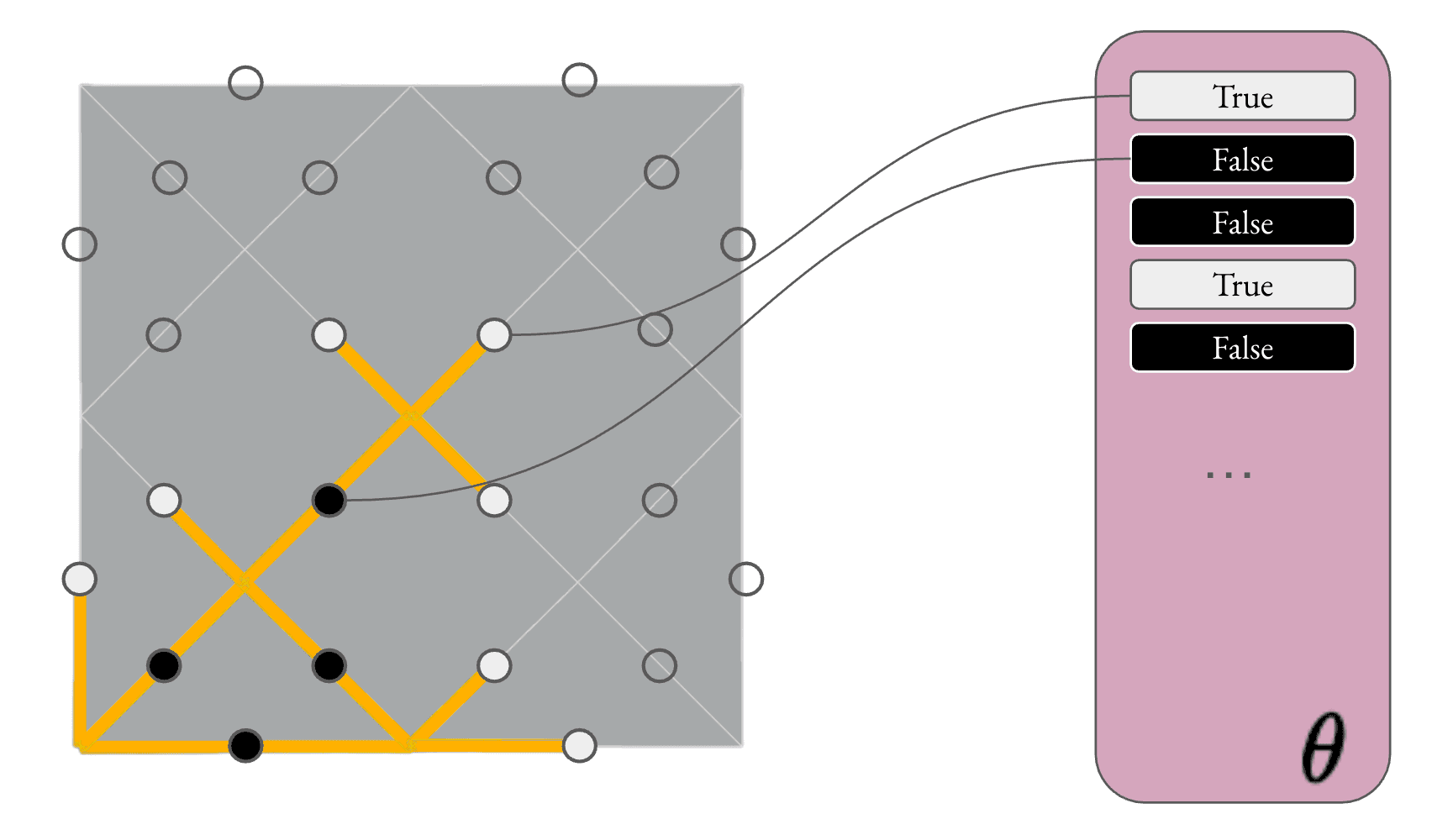
I framed this as a combinatorial optimization problem. The continuous geometry is first form-found via dynamic relaxation. A genetic algorithm then operates on a binary genome , where is the number of beams and each bit encodes the presence or absence of a joint.
The objective function balances three competing terms:
- is a penalty for panels exceeding container dimensions, computed via PCA to find the minimal oriented bounding box:
- is the total joint count, minimized to reduce assembly time and preserve continuity
- is the elastic energy evaluated on the fly by an embedded physics solver, so the algorithm directly feels the structural cost of each topological decision
The search space grows as , which is combinatorially intractable by brute force. The genetic algorithm navigates it through selection, crossover, and mutation, converging toward discretizations that are simultaneously transportable, efficient to assemble, and structurally sound.

The Result
The pipeline transforms an architectural vision into a shippable reality, not by simplifying the geometry but by finding the cuts that cost the least. It is a tool for circular architecture: proving that the logic of disassembly, when taken seriously enough to be encoded as an optimization target, can be just as generative as the logic of form.