CVAE + LCA
↗maximepollet27/Projet3A-GCDATThe Problem
The construction sector is one of the largest contributors to global emissions, yet early-stage design still relies mostly on intuition and experience. Life Cycle Assessment, the rigorous accounting of a building's environmental impact from material extraction to demolition, is computationally expensive and arrives too late in the process to meaningfully shape form. My goal was to reframe sustainable form-finding strictly as a machine learning challenge: embed the full cost of a design decision into the generative process itself.
The Approach
The project has two distinct phases, corresponding to the forward and inverse problems.
Surrogate modeling. I first trained a Multilayer Perceptron on a dataset of over 90,000 parametrically generated buildings to predict eight LCA indicators (embodied carbon, energy use, water consumption, and others) directly from geometric and material parameters. This surrogate bypasses costly physical simulation entirely, making real-time evaluation tractable.
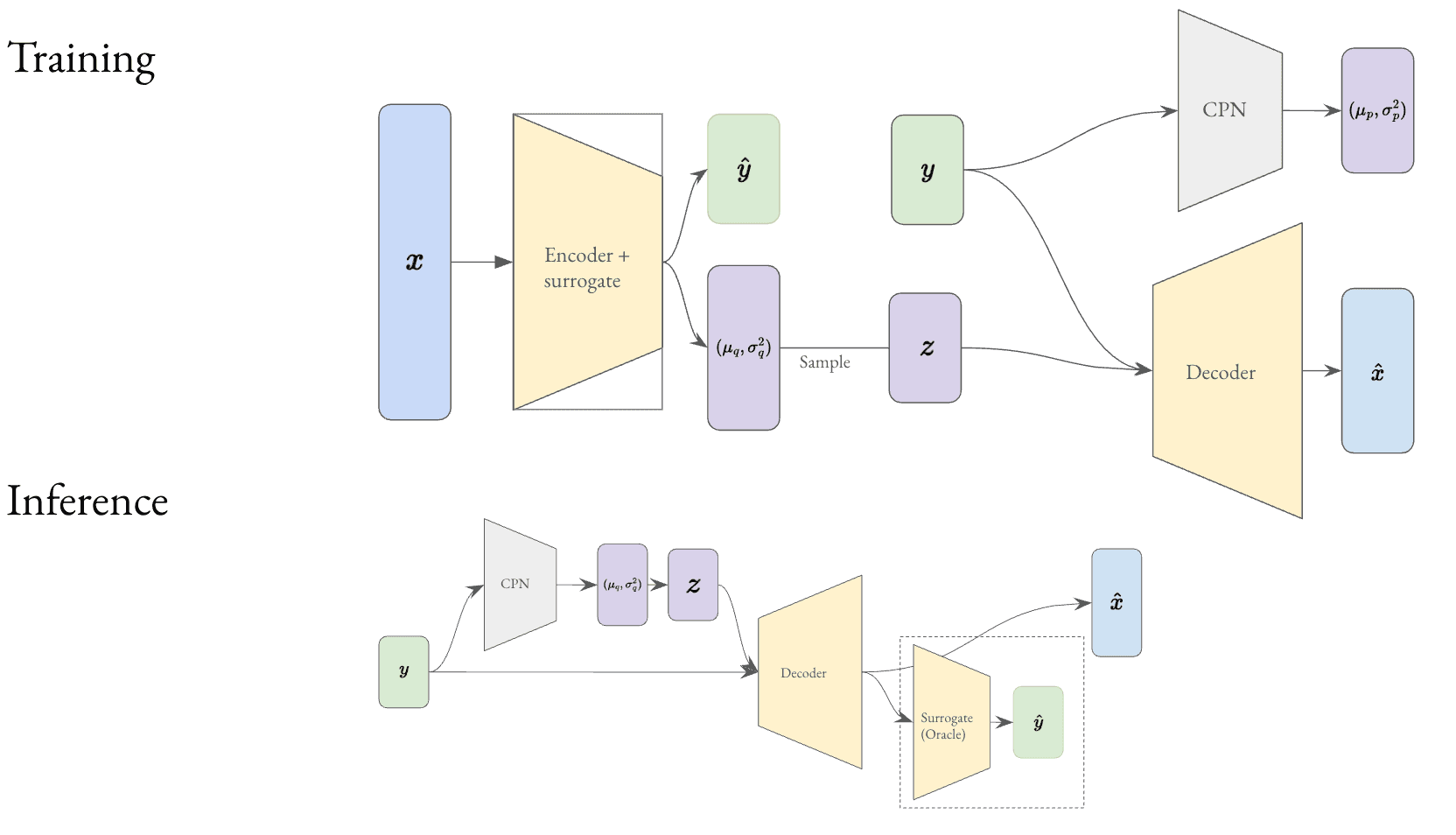
Inverse design. With the forward problem solved, I tackled the harder question: given a set of environmental constraints, what geometries satisfy them? I trained a Conditional Variational Autoencoder conditioned on those eight indicators simultaneously. The model is trained by maximizing the evidence lower bound:
where is the structural configuration, is the environmental condition vector, and is the latent variable. Rather than optimizing toward a single objective, the CVAE learns to propose diverse structural configurations that live within a specified environmental envelope: a generative model for the feasible set.
Evaluation
Because no single design is optimal across all eight dimensions simultaneously, performance is evaluated on the Pareto front: the set of configurations for which no indicator can be improved without degrading another. The quality of the generative model is then measured by the hypervolume indicator , which captures the volume of objective space dominated by the front:
where is the Pareto front, is a reference point, and denotes the Lebesgue measure. A higher hypervolume means the model covers more of the achievable trade-off surface.
Exploring the latent space reveals the continuous topological transitions between material choices, structural geometries, and environmental profiles, making trade-offs legible and navigable. The result is an interactive, data-driven tool that gives designers direct access to the sustainable region of the design space, at the moment when it still matters.